终极一班3
书名:原来是美男|作者:笑无语|本书类别:古言|更新时间:11:45:06|字数:3896字
一 | 袅袅草药香 悠悠润童心 猎德幼儿园大班亲子走进 省博开展中草药探秘之旅 广州市天河区珠江新城猎德幼儿园与广东省博物馆相距仅1.4公里,省博作为猎德幼儿园丰富的社区文化教育资源,对幼儿博物意识萌发及各项能力培养发挥着重要作用。

二 |
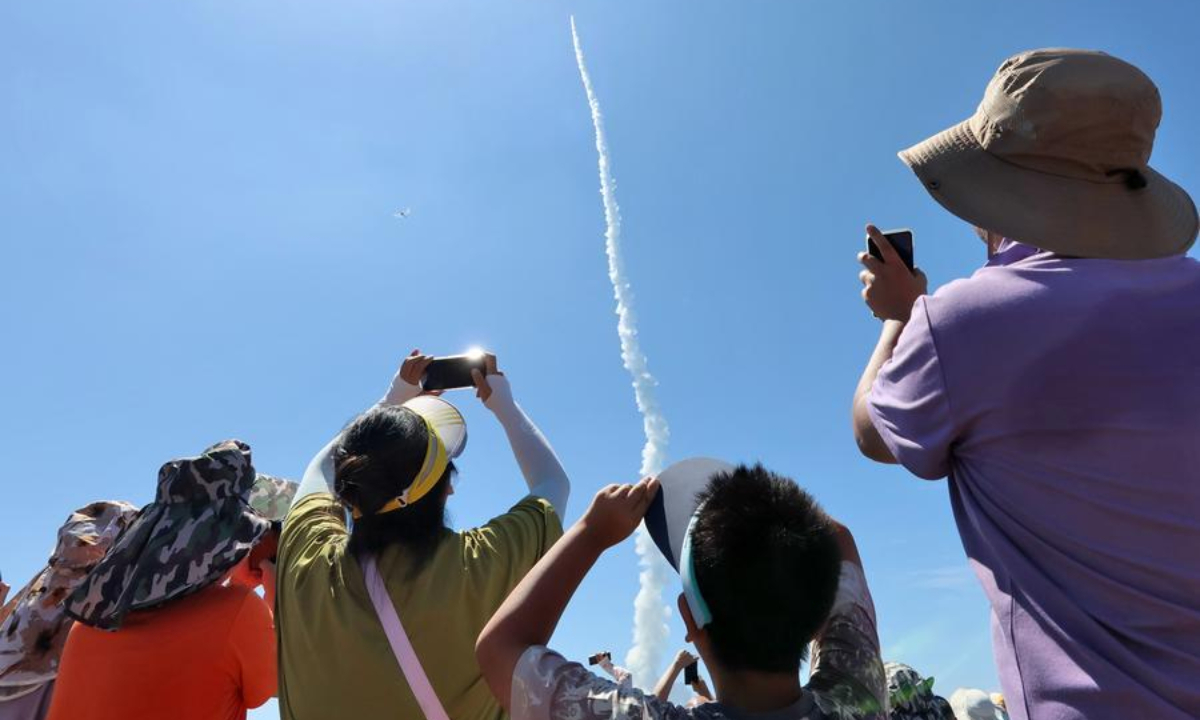
A burst of flame lit the morning sky over waters off Haiyang in east China's Shandong Province on Wednesday as a Smart Dragon-3 (SD-3) carrier rocket lifted off, drawing cheers from viewing sites along the coast.
Among the spectators were international students studying aerospace subjects in China. Aithana Perez, a Venezuelan aeronautical engineer studying space project management at Hangzhou Innovation Institute of Beihang University, said she and her classmates were excited because their studies involved spacecraft launch, design and operation.
For Marwane Oufrid, a 23-year-old Moroccan student in the same institute specializing in microsatellite technology, it was the first time he had watched a rocket launch in person.
The rocket blasted off at 10:38 a.m. (Beijing Time), delivering the Oriental Smart Eye hyperspectral satellites 01 and 02 into planned orbit.
In their respective cooperation projects with Indonesia and Uzbekistan, Satellite 01 is also known as Lampung-1 and Satellite 02 as Samarkand-2028.
Once in orbit, the satellites turned their attention back toward Earth. Lampung-1 is expected to monitor crop growth and disaster risks in Indonesia, while Samarkand-2028 is designed to support cotton cultivation and other land-monitoring applications in Uzbekistan.
Ordinary optical cameras mainly record the shape and color of objects. Hyperspectral imagers record a detailed spectrum for each image pixel, creating "spectral fingerprints" that can help determine the condition and composition of vegetation, water, soil and minerals.
These spectral "eyes" are paired with onboard AI computing modules capable of delivering up to 400 trillion operations per second. Instead of sending every raw image to the ground, the satellites can identify features, detect anomalies and extract useful information in orbit, potentially shortening delivery time from days to minutes.
Song Bingchen, co-founder of the Star.ai Spatio-temporal Intelligence Technology Co., Ltd., whose subsidiary STAR.VISION developed the satellites, compared the system to moving an AI inference platform from the ground into space.
"It changes the traditional model from transmitting images to transmitting results," Song said.
"Our satellite constellations are open to the world," Song noted, adding that the company welcomes international partners to jointly invest in, build and use the satellite networks.
In Indonesia, Lampung-1's planned applications are centered in Lampung Province on the island of Sumatra. Agriculture, forestry and fisheries accounted for 28.38 percent of the provincial economy in the third quarter of 2025. The satellite will also support marine resource management, environmental monitoring and disaster response.
Rahmat Mirzani Djausal, governor of Indonesia's Lampung Province, described the successful launch as a "historic moment" for the province.
"Cooperation with China on this satellite project is of historic and strategic significance," he said. "It marks the beginning of Lampung's transformation into a technologically advanced province."
The governor commended China's openness in sharing space technology and its commitment to long-term cooperation.
"China understands that any problems we face on one side of the world will ultimately impact the other side. Therefore, it is essential to empower regions that are left behind to make the world ultimately a better place," he said.
This cooperation also extends to people. Lampung is preparing to send over 100 young professionals to China for training in remote sensing and satellite communications, with the goal of building local capacity in satellite operation, data processing and spatial analysis.
In Uzbekistan, the applications center on cotton, grain and vegetation monitoring. Samarkand-2028 is designed to follow cotton cultivation from sowing to harvesting, while Uzbekcosmos has said hyperspectral data will also be used to produce national cotton and wheat maps.
Mukhiddin Ibragimov, deputy director of the Uzbekcosmos Agency, described the project as one of the largest international space projects in Uzbekistan's history and a milestone in its national space program.
He called the launch "a great occasion," saying it was the first time Uzbekistan had participated in an international space mission of such scale.
Ibragimov said Uzbekistan sent a technical team to China early in the project and formed a working group with Chinese specialists to develop an AI model for onboard data analysis. This model focuses on crop classification, including cotton verification, grain identification and vegetation monitoring.
The resulting data will support agriculture, water resource management, environmental protection and emergency monitoring, among other applications, he revealed.
Ibragimov said no single country can handle all space-related tasks alone.
"We believe that partnership brings value. We see that China is doing the same thing," he said, adding that Uzbekistan is exploring further satellite cooperation with China.
The projects offer a commercial example of the approach set out in China's 2021 space white paper, which called for international cooperation based on equality, mutual benefit, peaceful utilization and inclusive development.
Back in Haiyang, Oufrid said projects of this kind could give more countries an opportunity to participate in the space sector. He expressed the hope to see such cooperation happen more often and "maybe someday with Morocco as well."
。凭着独特的地理优势,猎德幼儿园开办以来积极集结学前教育及博物馆教育的优势与力量,赋能猎德幼儿园民俗文化课程开展。 为引导幼儿通过实地参观与互动体验近距离感受中草药文化的魅力,激发他们对中华传统草药文化的兴趣与热爱,广州市天河区珠江新城猎德幼儿园结合地域传统文化积极开展“春暖花开话清明”主题系列活动,于2025年2月28日组织大班级亲子走进广东省博物馆“广东省自然资源展厅”参观,进一步联动社区资源推进馆园共育。

三 | 中草药是中医药文化不可或缺的组成部分,与我们的生活息息相关。从神农尝百草开始,人们对中草药的探索已经经历了几千年的历史。

四 | 孩子们与草药的邂逅会碰撞出怎样的火花呢? 01 准备充分 翘首以盼 活动前期,教师们积极筹备,开展年级教研,挖掘中草药资源,梳理其涵盖的关键经验,并探究将其转化为契合幼儿发展水平的课程内容的有效路径,继而与幼儿共同展开充分交流。

五 | 孩子们通过发现身边常见的中草药、围绕地道药材展开讨论与分享,记录疑问并收集相关信息,共同制定参观计划。 / 02 草药奇缘 童心探秘 活动当天,孩子们在爸爸妈妈陪同下,带着好奇与兴奋大步迈进省博自然资源展厅的岭南本草展厅。淡淡的草药香气扑面而来,百余件腊叶标本、包埋标本、塑化标本等不同类型的标本陈列其中,展示广东的岭南道地药材和民间药材。亲子们在参观中了解金银花、菊花、枸杞、鸡骨草等常见药用植物及巴戟、沉香、穿心莲和化州橘红等独具特色的“南药”,并通过广东医事、百草堂等场景深入了解广东独特的中医药文化。 讲解员以通俗易懂的语言向孩子们介绍了中草药的名称、功效以及背后的文化故事。孩子们听得津津有味,还参与了互动体验环节,他们用手触摸草药模型,用鼻子闻一闻草药气味,在老师指导下尝试用放大镜观察草药细节,兴奋交流着自己的发现,现场氛围热烈。 / 03 结语 此次亲子参观活动是幼儿园优秀传统文化浸润教育的一次生动实践,孩子们深刻感受到了中华传统草药文化的博大精深。通过亲身接触与体验,孩子们对自然与科学产生了浓厚的兴趣,在心中种下了文化传承的种子。猎德幼儿园将持续拓展地域民俗文化融入教育实践的活动形式,深化课程内涵,让孩子们在探索中学习,在体验中成长,为其全面发展奠定坚实基础。 ✦ • ✦ ✦ 左右滑动,查看更多 ✦ 图片提供:大班级教师 图文编辑:陈肖冰、高懿涵 校对审核:杨蕾、符静思 广州市天河区珠江新城猎德幼儿园 2025年3月1日。


